
 By Kylie White
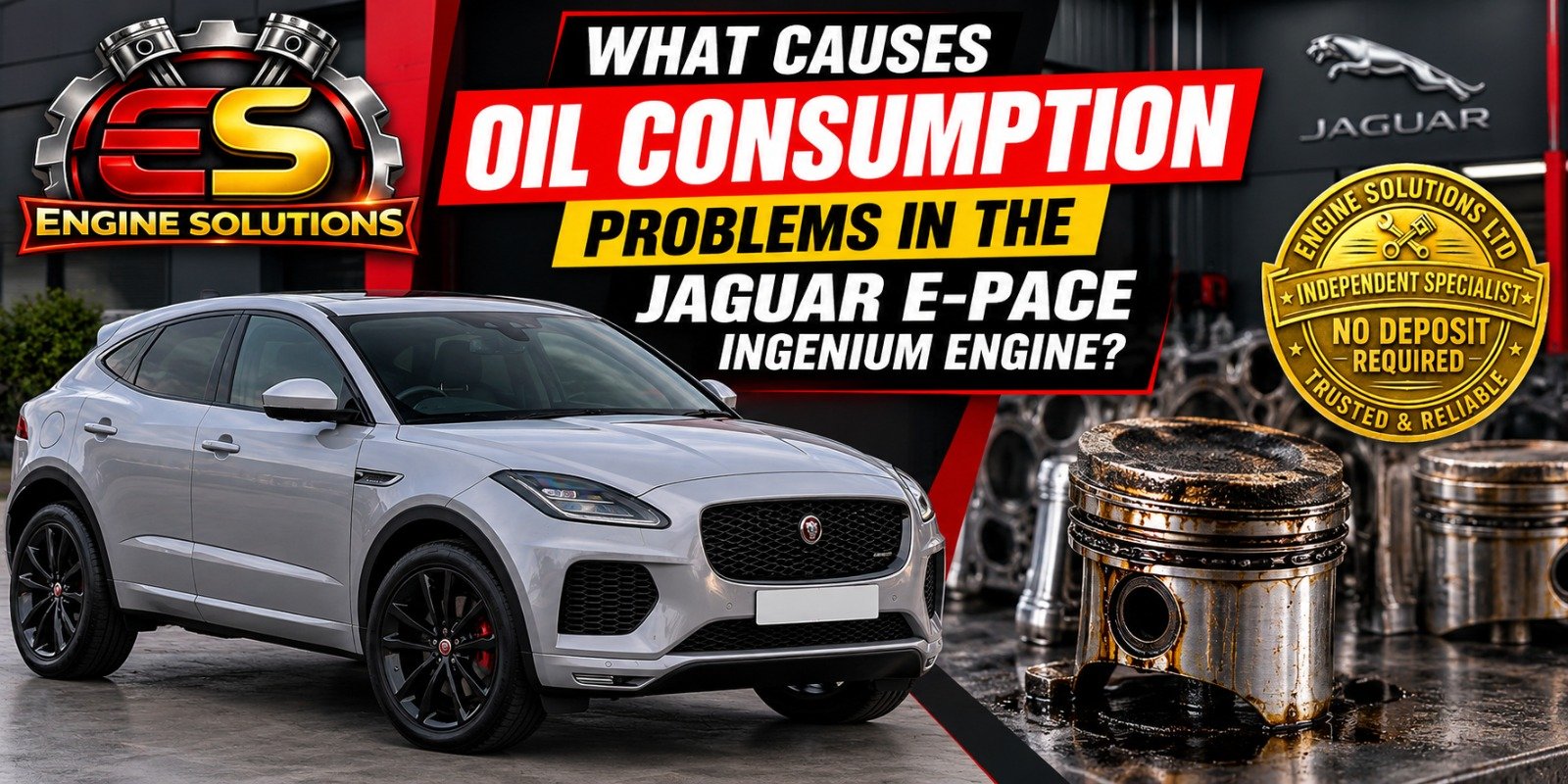
Jaguar E-Pace oil consumption is a growing concern for owners, especially on higher-mileage cars with the 2.0 Ingenium petrol and diesel engines. Every engine uses a small amount of oil. But if you’re topping up between services or seeing low oil level warnings, something is wrong.
Burning too much oil is more than an inconvenience. If the oil level drops too low, the timing chain, turbocharger and bearings lose protection. That can quickly lead to serious damage and a full engine replacement.
The E-Pace is Jaguar’s compact performance SUV. It shares its Ingenium engine family with other JLR models, including the PT204 petrol that also powers the Jaguar engine F-Type P300. These are efficient, lightweight aluminium engines, but they’re sensitive to oil quality, servicing and wear.
In this guide, the team at Engine Solutions in Grays explains:
- what causes oil consumption problems in the E-Pace Ingenium engine
- the warning signs to look for
- engine codes and specifications
- when an engine rebuild or replacement is needed
We also cover engine replacement costs in the UK and our nationwide supply and fit services.
How Much Oil Use Is Normal, and What Are the Warning Signs?
A small amount of oil use is normal on any modern engine, especially during hard driving or long motorway trips. As a rough guide, if your E-Pace needs more than about 1 litre of oil every 1,000 to 1,500 miles, it’s worth investigating. Using oil faster than this usually points to internal wear or a fault that will get worse over time.
Common warning signs include:
- a low oil level message on the dashboard
- frequent top-ups between services
- blue or grey smoke from the exhaust, especially at start-up or when accelerating
- a burning oil smell
- oily residue around the exhaust tailpipe
- oil spots under the car
- fouled spark plugs on petrol models, which can cause misfires
On diesel models, watch out for the opposite problem too. A rising oil level can mean fuel is diluting the oil during DPF regeneration. This thins the oil and increases wear.
If you notice any of these symptoms, check your oil level weekly, top up with the correct Jaguar-approved oil, and book a diagnostic check as soon as possible.
Main Causes of Oil Consumption in the E-Pace Ingenium Engine
Several known faults can cause the Ingenium engine to burn or lose oil:
- Worn or stuck piston rings: Carbon build-up, often from short journeys and long gaps between services, can make the rings stick and let oil into the combustion chamber.
- Faulty PCV or breather valve: On the PT204 petrol engine, a failed positive crankcase ventilation (PCV) valve can pull oil into the intake, causing smoke and high oil use.
- Worn turbocharger seals: These let oil pass into the intake or exhaust, often causing blue smoke under boost.
- Worn valve stem seals: These let oil drip into the cylinders, which is especially noticeable at start-up.
- External oil leaks: Common leak points include the cam cover gasket, oil cooler, vacuum pump and rear main seal.
- Cylinder bore wear or scoring: Often caused by poor oil quality or overheating.
Oil dilution on diesels and long service intervals make many of these problems worse. You can help prevent oil consumption problems by:
- changing the oil regularly
- using the correct oil specification
- letting the engine reach full temperature on your journeys
Jaguar E-Pace Engine Specifications and Engine Codes
Before you buy a replacement Jaguar engine, you need to confirm your engine code. The code makes sure the replacement matches your E-Pace’s gearbox, ECU, emissions system and, on later models, mild hybrid setup.
- 2017 launch (X540): The E-Pace launched with 2.0 Ingenium diesel and petrol engines.
- From 2021: Most versions gained 48-volt mild hybrid (MHEV) technology, and a 1.5 three-cylinder plug-in hybrid was added.
You can find your engine code on the V5C logbook or the engine block, or our team can check it from your registration number.
Table:
| Engine Model | Engine Code | Fuel | Capacity | Power | Torque | Years (approx.) |
| 2.0 Ingenium Diesel (D150 / D180) | 204DTD | Diesel | 1,999cc | 150–180 PS | 380–430 Nm | 2017–2020 |
| 2.0 Ingenium Twin-Turbo Diesel (D240) | 204DTA | Diesel | 1,999cc | 240 PS | 500 Nm | 2017–2020 |
| 2.0 Ingenium Diesel MHEV (D165 / D200) | 204DTD | Diesel | 1,999cc | 163–204 PS | 380–430 Nm | 2021–2024 |
| 2.0 Ingenium Petrol (P200 / P250) | PT204 | Petrol | 1,997cc | 200–249 PS | 320–365 Nm | 2017–2024 |
| 2.0 Ingenium Petrol (P300) | PT204 | Petrol | 1,997cc | 300 PS | 400 Nm | 2017–2024 |
| 2.0 Ingenium Petrol MHEV (P200 / P250) | PT204 | Petrol | 1,997cc | 200–249 PS | 320–365 Nm | 2021–2024 |
| 1.5 Ingenium Plug-in Hybrid (P300e) | 1.5 Ingenium I3 + e-motor | Petrol/Electric | 1,497cc | 309 PS combined | 540 Nm combined | 2021–2024 |
Figures are approximate and can vary by year and market.
Oil consumption problems are most often reported on the PT204 petrol engine. The 204DTD diesel is more prone to oil dilution and timing chain wear.
The PT204 petrol is also used in the Jaguar engine F-Type P300, as well as the XE, XF and F-Pace. That means replacement engines and parts are widely available, which helps keep repair times and costs down.
Diagnosis: Engine Rebuild or Engine Replacement?
The first step is finding the real cause of the oil consumption. A professional diagnosis may include:
- an oil consumption test
- a compression test
- a cylinder leak-down test
- a camera (borescope) inspection of the cylinders
- checks on the PCV valve and turbocharger
Some causes, such as a failed PCV valve, a leaking gasket or a worn turbo, can be repaired without removing the engine. These repairs are often quick and affordable if the problem is caught early.
If the tests show worn piston rings, scored cylinder bores or damaged valve stem seals, the engine will need major work. In this case, you have two main options.
An engine rebuild means stripping the engine, replacing the pistons, rings, bearings, seals and gaskets, and machining the cylinder head and bores where needed. It can be good value if the block is in good condition.
However, if the bores are badly scored, or low oil has already damaged the bearings, crankshaft or timing chain, an engine replacement is usually quicker and more cost-effective. At Engine Solutions, we explain what we find clearly and give honest advice before any work begins.
Reconditioned Engines vs Used Engines
If your E-Pace needs a new engine, the next step is comparing reconditioned engines vs used engines.
Used engines:
- are taken from a donor vehicle and fitted after basic checks, such as a compression or oil pressure test
- are the cheapest option
- often have an unknown history
- with Ingenium engines, may already have worn piston rings, a weak PCV system or a stretched timing chain, so the same oil consumption problems could return soon after fitting
Reconditioned engines:
- are fully stripped, cleaned and inspected
- have worn and high-risk parts replaced with new ones, including piston rings, valve stem seals, timing chains, tensioners, bearings, seals and gaskets
- have the cylinder bores and head measured, machined and pressure tested where needed
- are tested before they leave our workshop
- are brought close to factory standard and come with a longer warranty
For most E-Pace owners, we recommend a reconditioned engine. It costs more upfront than a used engine, but it removes the known causes of oil burning and gives you long-term reliability.
Engine Replacement Costs in the UK
Engine replacement costs in the UK for a Jaguar E-Pace depend on three things: the engine type, whether you choose a used or reconditioned unit, and the labour involved. Most E-Pace engines are 2.0 Ingenium four-cylinder units, which are quicker to fit than larger six-cylinder or V8 engines. However, mild hybrid and plug-in hybrid models need extra checks on their electrical systems, which can add time.
Main dealers often quote very high prices for brand-new engines, but a specialist like Engine Solutions can supply and fit a quality reconditioned JLR engine for much less. The guide prices below include supply and fit.
| Repair / Engine | Used Engine (Supply & Fit) | Reconditioned Engine (Supply & Fit) |
| PCV valve or breather repair | £150 – £450 (repair) | — |
| 2.0 Ingenium Diesel (204DTD) | £2,800 – £3,800 | £3,800 – £5,200 |
| 2.0 Ingenium Twin-Turbo Diesel (204DTA) | £3,200 – £4,300 | £4,300 – £5,800 |
| 2.0 Ingenium Petrol (PT204) | £3,000 – £4,200 | £4,200 – £5,800 |
| 1.5 Ingenium PHEV (P300e) | £3,200 – £4,400 | £4,400 – £6,000 |
Our quotes include the engine, labour, oil, coolant and new filters, with no hidden extras. We offer No Upfront Charges and No Deposit Required, so you only pay once the work is complete and you’re happy. Prices change with stock and engine condition, so send us your registration for an exact quote.
Buy a Jaguar Engine for Sale With Supply and Fit Services and UK-Wide Logistics
When you’re ready to buy a reliable Jaguar engine for sale, Engine Solutions in Grays, UK, makes the process quick and simple. Shop our range of reconditioned and used E-Pace engines, covering all the major engine codes, including the 204DTD, 204DTA and PT204. We also supply engines for other Jaguar models, such as the F-Pace, XE, XF and F-Type.
Our full supply and fit services handle every step:
- diagnosis
- sourcing the correct engine
- removing the old engine
- professional fitting
- fluid fill
- software coding
- a final road test
We also take care of all the logistics:
- Collection and recovery: We can collect your E-Pace from anywhere in the UK.
- Safe transport: We bring it to our workshop in Grays and return it to your door once the job is finished.
- Engine delivery: If you’d rather use your own garage, we offer fast, fully insured nationwide delivery on a pallet, with tracking and secure packaging.
Best of all, there are No Upfront Charges and No Deposit Required, so you can book with complete confidence. Buy a quality replacement engine at a fair price and get your Jaguar back on the road quickly. Contact Engine Solutions today for a free quote.
Frequently Asked Questions
1. How much oil should a Jaguar E-Pace use?
Some oil use is normal, but needing more than about 1 litre every 1,000 to 1,500 miles is a warning sign. Have the engine checked if you’re topping up often.
2. What is the most common cause of oil burning in the E-Pace?
On the PT204 petrol, a failed PCV valve and stuck piston rings are the most common causes. Worn turbo seals and valve stem seals can also be to blame.
3. Can I keep driving if my E-Pace is using oil?
Only if you check and top up the level regularly. Running low on oil can damage the timing chain, turbo and bearings, so book a diagnosis quickly.
4. How much does an E-Pace engine replacement cost in the UK?
Supply and fit prices usually range from about £2,800 for a used 2.0 diesel to around £6,000 for a reconditioned PHEV engine. A PCV valve repair costs much less.
5. Do I need to pay a deposit?
No. Engine Solutions offers No Upfront Charges and No Deposit Required, plus UK-wide vehicle collection and engine delivery.