
 By Kylie White
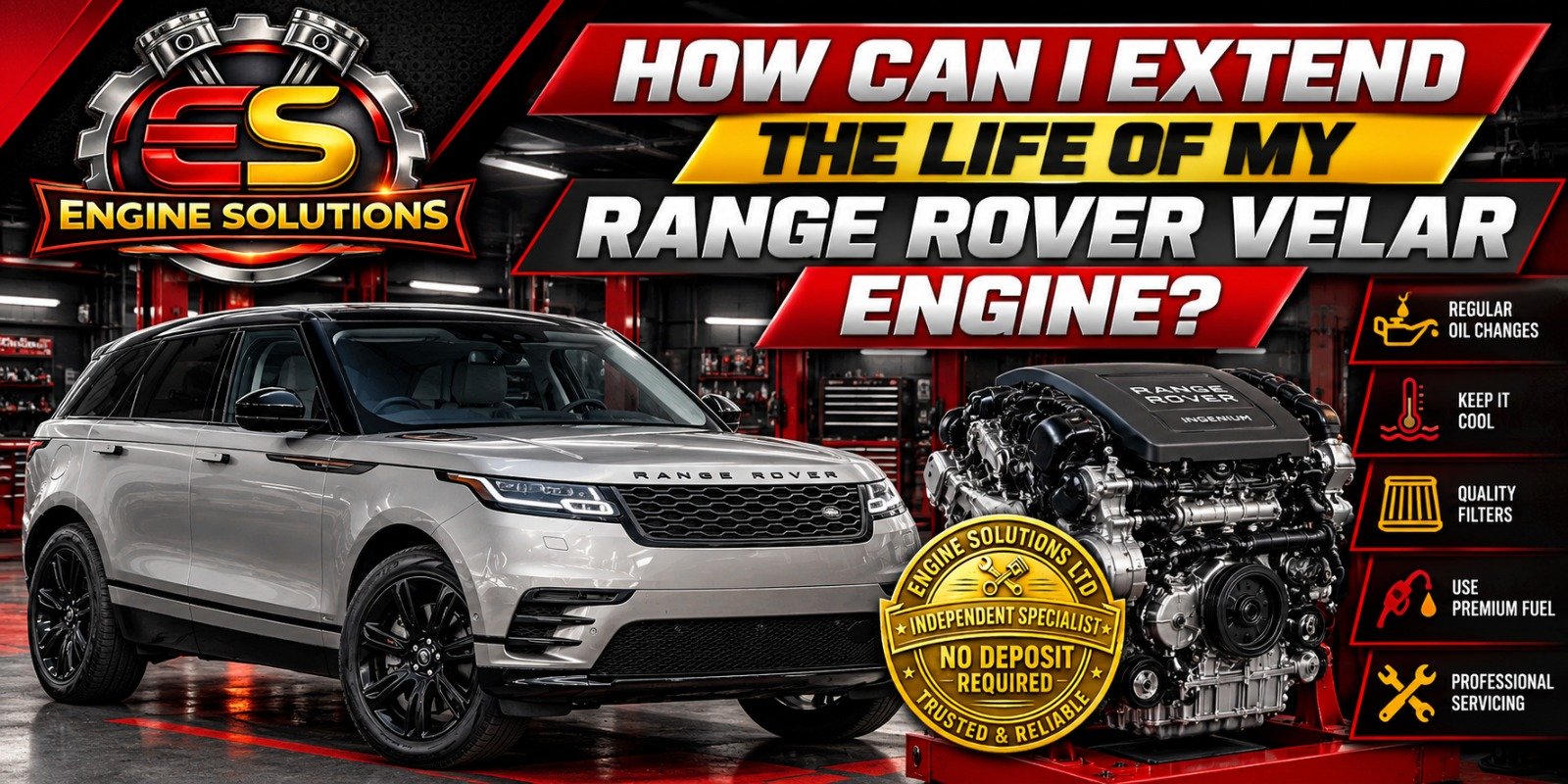
The Range Rover Velar is stylish, comfortable and packed with modern technology. Under the bonnet, however, its engines are complex and need the right care to last. With good habits and regular servicing, a Range Rover Velar engine can easily go well beyond 150,000 miles. On the other hand, neglect can lead to costly repairs or a full engine replacement. At Engine Solutions in Grays, UK, we service, rebuild and replace Velar engines every week. In this guide, we share practical tips, engine codes, specifications and UK repair costs.
Know Your Range Rover Velar Engine
The first step to protecting your engine is knowing which one you have. Since 2017, the Velar has been sold with several diesel and petrol engines. Each one has its own service needs and weak points.
| Engine | Years | Engine Code | Size | Power | Torque |
| D180 | 2017–2020 | 204DTD | 2.0 L I4 diesel | 180 PS | 430 Nm |
| D240 | 2017–2020 | 204DTA | 2.0 L I4 twin-turbo diesel | 240 PS | 500 Nm |
| D200 MHEV | 2020–2023 | 204DTD (MHEV) | 2.0 L I4 diesel | 204 PS | 430 Nm |
| D275 / D300 | 2017–2020 | 306DT | 3.0 L V6 diesel | 275–300 PS | 625–700 Nm |
| D300 MHEV | 2021–2023 | DT306 | 3.0 L I6 diesel | 300 PS | 650 Nm |
| P250 / P300 | 2017–2023 | PT204 | 2.0 L I4 petrol | 250–300 PS | 365–400 Nm |
| P340 / P380 | 2017–2020 | 306PS (AJ126) | 3.0 L V6 supercharged | 340–380 PS | 450–460 Nm |
| P400 MHEV | 2020–2023 | PT306 | 3.0 L I6 petrol | 400 PS | 550 Nm |
| P400e PHEV | 2021–present | PT204 + motor | 2.0 L I4 hybrid | 404 PS | 640 Nm |
| SVAutobiography | 2019–2023 | 508PS (AJ133) | 5.0 L V8 supercharged | 550 PS | 680 Nm |
You can find your engine code on the V5C, in the service book or on the engine itself. Alternatively, send us your VIN and our Range Rover Engine Works team will confirm it for you.
Range Rover Velar Engine Specifications
Most UK Velars use the 2.0-litre Ingenium diesel or the 3.0-litre V6 diesel. Here are their key specifications.
2.0 Ingenium Diesel (204DTD / 204DTA)
- Layout: Inline four-cylinder, DOHC, 16 valves
- Displacement: 1,999 cc
- Bore x stroke: 83.0 mm x 92.4 mm
- Compression ratio: 15.5:1
- Induction: Single turbo (D180) or sequential twin turbos (D240)
- Fuel system: 2,000-bar common-rail injection
- Camshaft drive: Timing chain at the rear (gearbox end)
- Emissions: DPF and AdBlue (SCR)
3.0 V6 Diesel (306DT)
- Layout: 60° V6, DOHC, 24 valves
- Displacement: 2,993 cc
- Bore x stroke: 84.0 mm x 90.0 mm
- Compression ratio: 16.1:1
- Induction: Parallel sequential twin turbos
- Block: Compacted graphite iron
Each engine has known weak points. The 2.0 Ingenium can suffer from timing chain stretch and oil dilution. The 3.0 V6 diesel, meanwhile, is known for crankshaft and bearing failure when oil care is poor. Luckily, the right maintenance greatly reduces both risks.
Regular Servicing and Using the Right Oil
Oil is the lifeblood of your Range Rover engine. Most serious Velar engine failures, including timing chain and bearing damage, come back to oil problems.
Land Rover’s service schedule can allow up to 21,000 miles or two years between oil changes. However, for long engine life, we recommend changing the oil and filter every 8,000 to 10,000 miles, or once a year. This is especially important if you mostly drive short trips or tow.
Always use the exact JLR-approved oil grade and specification listed in your handbook. The wrong oil can reduce protection for the turbos, chains and bearings.
In addition, follow these servicing tips:
- Check the oil level every two weeks, and watch for any rise in level on diesels.
- Change the fuel filter on time to protect the injectors.
- Replace the coolant and air filter at the correct intervals.
- Make sure all software updates and recalls are done.
- Keep every receipt, because a full service history adds value and supports warranty claims.
Using a specialist Range Rover garage in Grays means your Velar gets the correct parts and expert care at every service.
Smart Driving Habits and Warning Signs to Watch
How you drive has a big impact on your Velar’s engine life. Follow these simple habits:
- Warm up gently. Avoid high revs until the engine reaches normal temperature.
- Let the turbo cool. After hard driving or towing, idle for 30 to 60 seconds before switching off.
- Avoid too many short trips. Short runs stop the DPF from regenerating. As a result, extra fuel can thin the oil.
- Take regular motorway drives. A 20 to 30-minute run every couple of weeks helps the DPF clean itself.
- Keep AdBlue topped up and use good-quality fuel from busy stations.
Just as importantly, don’t ignore warning signs. Look out for:
- A rattle on cold start, which can point to timing chain wear
- Knocking under load, which can mean bearing damage
- A rising oil level or frequent DPF warnings
- Coolant loss, overheating or white smoke
- Loss of power or limp mode
If you notice any of these, book an inspection straight away. Early repairs cost far less than a full engine replacement.
Engine Rebuild vs Engine Replacement: UK Costs
Even well-maintained engines can sometimes fail. If that happens, you have two main options: an engine rebuild or an engine replacement.
An engine rebuild repairs your existing engine. It works well when the block and crankshaft are still in good condition. A replacement, on the other hand, swaps in a reconditioned engine. This is usually faster and is the better choice after major damage.
Here’s a guide to engine replacement costs in the UK for the Velar:
- Timing chain repair (2.0 Ingenium): around £1,500 to £3,000
- Engine rebuild of your own unit: around £3,000 to £6,000
- Reconditioned 2.0 diesel, supplied and fitted: around £3,500 to £5,500
- Reconditioned 3.0 V6 diesel, supplied and fitted: around £4,500 to £7,000
- Reconditioned 3.0 I6 MHEV, supplied and fitted: around £6,000 to £9,000
By comparison, a new engine from a main dealer can cost more than double these amounts. Your final price depends on the engine, its condition and any extra parts needed. For that reason, we always give a fixed, itemised quote before starting work.
Reconditioned Engines vs Used Engines
When comparing reconditioned engines vs used engines, think about reliability as well as price. A used engine comes from a donor vehicle with an unknown history. If it has suffered from oil dilution or a stretched timing chain, you’ll inherit the same problems.
Reconditioned engines, on the other hand, are fully stripped, cleaned and inspected. During the rebuild, we fit a new timing chain, guides and tensioners. We also replace bearings, seals and gaskets. Next, we check and machine the crankshaft and cylinder head where needed. Finally, every engine is rebuilt to factory tolerances and tested before it leaves our workshop.
As a result, the known Velar weak points are fixed before the engine reaches you. A reconditioned JLR engine also comes with a warranty, while most used engines don’t.
Although a used engine may seem cheaper, it can cost far more if it fails again. In the long run, a reconditioned engine usually gives better value and peace of mind. That’s why most of our customers choose to shop for reconditioned engines rather than used ones.
Supply and Fit Services at Our Range Rover Garage in Grays
At Engine Solutions, our supply and fit services make engine replacement simple. Our Range Rover garage in Grays works as a dedicated Range Rover Engine Works, focusing only on Jaguar and Land Rover vehicles.
First, we diagnose the fault using JLR-level equipment. Next, we source the correct engine to match your VIN. Then we fit it with fresh oil, filters, coolant and new gaskets. After that, we code the engine, update the software and road-test your Velar before handover.
Most importantly, we offer No Upfront Charges and No Deposit Required. You only pay once the job is complete and you’re fully satisfied. This takes the stress and risk out of a major repair.
Every engine also comes with a warranty for extra peace of mind. We also offer servicing to help your new engine last longer. If you want to buy a reconditioned Range Rover Velar engine with expert fitting, contact our Grays team today for a free, no-obligation quote. We also stock a wide range of Range Rover engines for sale.
UK-Wide Logistics and Delivery From Grays
Engine Solutions is based in Grays, Essex, but we serve customers across the whole UK. Our logistics service makes engine replacement easy, wherever you live.
If your Velar can’t be driven, we can arrange vehicle recovery to our workshop from England, Scotland and Wales. Once the work is finished, we can return your vehicle to your home or business. Alternatively, if you prefer to use your local garage, we can deliver the engine directly to them.
Every engine is secured to a pallet, sealed against dirt and moisture, and shipped with a trusted courier. In addition, you get tracking updates from dispatch to delivery, so you always know when it will arrive.
Our Grays location is close to the M25, A13 and Port of Tilbury. As a result, we can deliver quickly to London, Essex, Kent and the rest of the country. Next-day delivery is also available on most stock engines. Simply put, you can shop with us online or by phone, and we’ll handle the rest.
Frequently Asked Questions
1. How long does a Range Rover Velar engine last?
With regular servicing and the right oil, a Velar engine can last 150,000 miles or more. Poor maintenance and short trips can greatly reduce its life.
2. How often should I change the oil in my Velar?
We recommend an oil and filter change every 8,000 to 10,000 miles, or once a year. This is more often than the official schedule, but it protects the chains and bearings.
3. What are the most common Velar engine problems?
The 2.0 Ingenium can suffer from timing chain stretch and oil dilution. The 3.0 V6 diesel can develop crankshaft and bearing failure.
4. Do I need to pay a deposit for engine replacement?
No. We offer No Upfront Charges and No Deposit Required, and you only pay once the job is complete.
5. Do you deliver Range Rover engines across the UK?
Yes. We offer tracked nationwide delivery and vehicle recovery from our base in Grays, Essex.