
 By Kylie White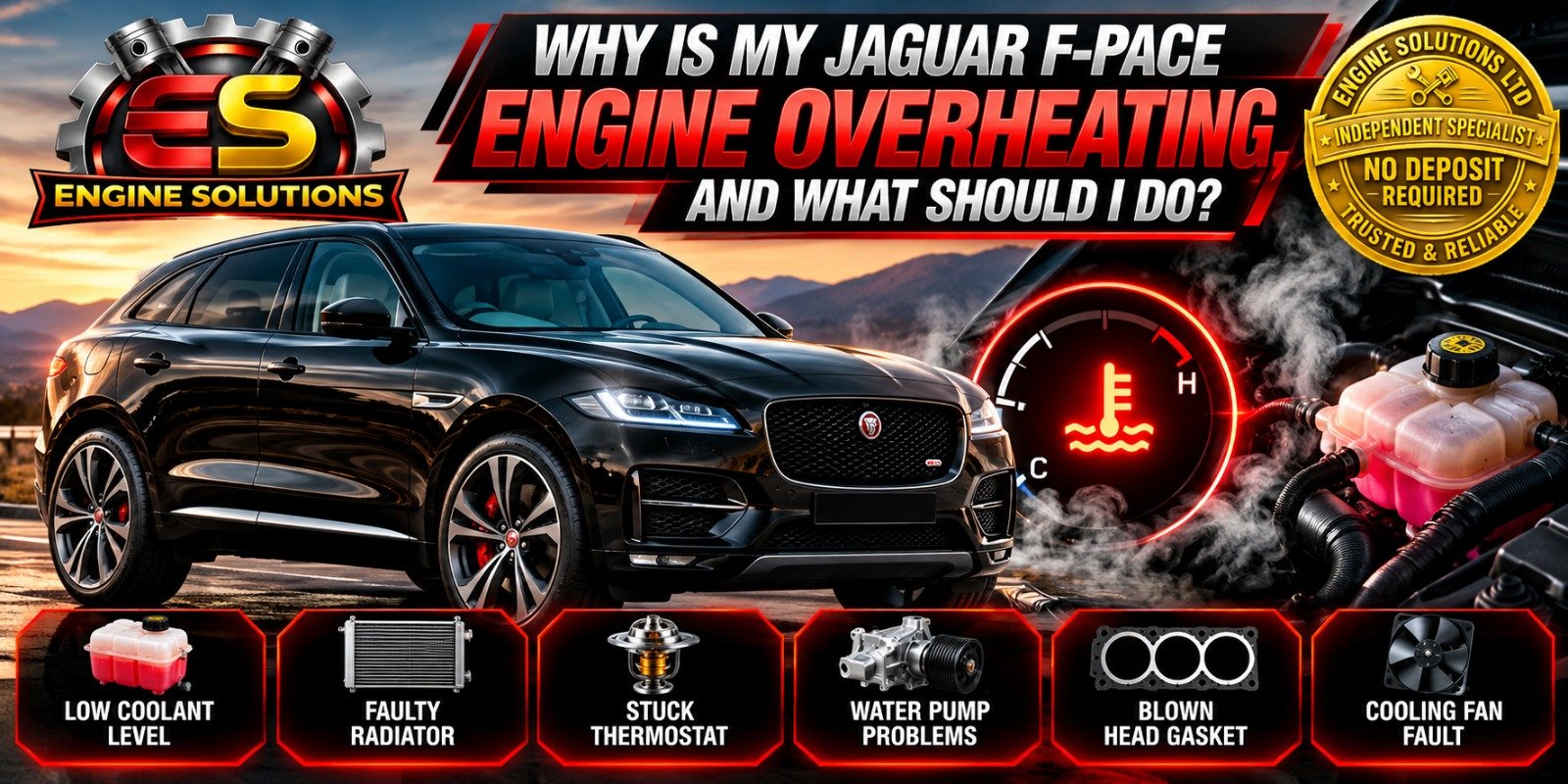
Jaguar F-Pace engine overheating is one of the most common problems owners bring to our workshop in Grays. The F-Pace is a powerful SUV, but its compact engine bay, turbochargers and high operating temperatures put heavy demands on the cooling system. When any part of that system fails, heat builds up fast and the temperature gauge climbs into the red.
Overheating is not a fault you can ignore. Running a hot Jaguar engine for even a few miles can warp the cylinder head, blow the head gasket and damage pistons, bearings and turbochargers. What starts as a cheap coolant leak can quickly become a full engine replacement.
The good news is that most overheating faults are easy to spot early if you know the warning signs. In this guide, the team at Engine Solutions explains the main causes, what to do the moment your F-Pace overheats, and how to choose between an engine rebuild, a reconditioned engine or a used unit. We also cover engine replacement costs in the UK, engine codes and our nationwide supply and fit services, so you can make the right decision for your car and your budget.
2. Common Causes of Jaguar F-Pace Engine Overheating
Most F-Pace overheating problems come from a handful of known weak points:
- Coolant pump (water pump): On the 2.0 Ingenium engines it can leak or fail, which stops coolant flowing properly.
- Coolant pipes and expansion tank: These plastic parts can crack with age and heat, causing slow leaks that owners often miss.
- Thermostat, radiator or cooling fan: A thermostat stuck closed traps hot coolant inside the engine. A blocked radiator or a failed fan cuts airflow, especially in slow traffic.
Low coolant caused by a head gasket failure is more serious. You may notice white smoke from the exhaust, bubbles in the expansion tank, or coolant loss with no visible leak. On diesel models, a leaking EGR cooler can also push coolant into the intake and cause overheating.
Other causes include:
- air locks after a coolant change
- the wrong type of coolant
- a failing temperature sensor that gives false readings
Because several faults share the same symptoms, a proper diagnostic check and pressure test is the quickest way to find the real cause before more damage is done to your Jaguar engine.
3. Warning Signs and What to Do Immediately
Spotting the early signs of overheating can save you thousands of pounds. Watch for:
- the temperature gauge rising above normal
- a coolant warning light on the dashboard
- a sweet smell of coolant
- steam from under the bonnet
- the car going into limp mode
- coolant levels that keep dropping
If your F-Pace starts to overheat, pull over safely as soon as you can and switch off the engine. Don’t keep driving to “get home”, because this is how most head gasket and cylinder head failures happen. Never open the coolant cap while the engine is hot, as pressurised coolant can cause serious burns.
Let the engine cool for at least 30 minutes, then check the coolant level and look for obvious leaks. If the level is low, you can top up with the correct Jaguar-approved coolant to reach a garage, but only if the car runs normally. If you see white smoke or milky oil, or the engine runs rough, don’t restart it. Arrange recovery and get a professional diagnosis.
4. Jaguar F-Pace Engine Specifications and Engine Codes
Knowing your engine code is essential when you buy a replacement Jaguar engine, because it makes sure the new unit matches your car exactly. The F-Pace has used several petrol, diesel and hybrid engines since its launch in 2016:
- The 2.0 Ingenium four-cylinder engines are the most common in the UK.
- The 3.0 V6 diesel and supercharged petrol units offer more power and towing ability.
- The SVR uses the famous 5.0 supercharged V8.
You can usually find the engine code on your V5C logbook or on the engine itself, or you can give us your registration number. If you’re unsure which engine your F-Pace has, our team can confirm it in minutes.
Table
| Engine Model | Engine Code | Fuel | Capacity | Power | Years (approx.) |
| 2.0 Ingenium Diesel (20d / D180 / D200) | 204DTD (AJ200D) | Diesel | 1,999cc | 163–204 PS | 2016–2023 |
| 2.0 Ingenium Twin-Turbo Diesel (25d / D240) | 204DTA | Diesel | 1,999cc | 240 PS | 2017–2020 |
| 2.0 Ingenium Petrol (25t / 30t / P250 / P300) | PT204 (AJ200P) | Petrol | 1,997cc | 250–300 PS | 2017–present |
| 3.0 V6 Diesel (30d) | 306DT (AJV6D) | Diesel | 2,993cc | 300 PS | 2016–2020 |
| 3.0 V6 Supercharged (35t / S 380) | AJ126 (306PS) | Petrol | 2,995cc | 340–380 PS | 2016–2020 |
| 5.0 V8 Supercharged (SVR) | AJ133 (508PS) | Petrol | 5,000cc | 550 PS | 2019–present |
| 3.0 Ingenium Straight-Six Diesel MHEV (D300) | DT306 | Diesel | 2,997cc | 300 PS | 2021–present |
| 3.0 Ingenium Straight-Six Petrol MHEV (P400) | PT306 | Petrol | 2,996cc | 400 PS | 2020–present |
| 2.0 Ingenium Plug-in Hybrid (P400e) | PT204 + e-motor | Petrol/Electric | 1,997cc | 404 PS combined | 2021–present |
The Ingenium engines use aluminium blocks and heads. This makes them light and efficient, but also more sensitive to overheating damage, which is why acting fast matters so much on these models.
5. Engine Rebuild or Engine Replacement: Which Is Right?
Once overheating has caused internal damage, you usually have two options: an engine rebuild or an engine replacement.
An engine rebuild means stripping your existing engine, machining or replacing damaged parts such as the cylinder head, pistons, bearings and gaskets, and then putting it back together. A rebuild can be a good choice if the damage is limited and the block is still sound, as you keep your original engine.
However, severe overheating often warps the aluminium head and block on Ingenium engines, cracks liners or seizes the crankshaft. In these cases a rebuild can become expensive and take longer, with no guarantee that all the hidden damage has been found.
An engine replacement swaps the damaged unit for a reconditioned or used Jaguar engine. This is often quicker and better value, and it comes with a fresh warranty.
At Engine Solutions, we inspect your engine first and give honest advice. If a rebuild makes sense, we’ll tell you. If replacement is the better value, we’ll show you clear options and prices so you can decide with confidence.
6. Reconditioned Engines vs Used Engines
Many drivers ask us about reconditioned engines vs used engines. The right choice depends on your budget and how long you plan to keep the car.
Used engines:
- taken from a donor vehicle and fitted as they are, usually after basic checks such as a compression test
- the cheapest option
- history and remaining life can be uncertain, and warranties are often short
Reconditioned engines:
- fully stripped, cleaned, inspected and rebuilt to strict standards
- worn or damaged parts replaced with new ones, including gaskets, seals, bearings, timing chains and piston rings where needed
- cylinder head pressure tested and skimmed, and the engine checked before it leaves our workshop
- near-new reliability, more peace of mind and a longer warranty
For an F-Pace that has overheated, we generally recommend a reconditioned engine. This is especially true for the 2.0 Ingenium and 3.0 V6 diesel units, where timing chain and cooling issues are common. It costs more upfront than a used engine, but it usually saves money over the life of the car.
7. Engine Replacement Costs in the UK
Engine replacement costs in the UK for a Jaguar F-Pace depend on three things: the engine type, whether you choose a used or reconditioned unit, and the labour involved. Larger engines such as the 3.0 V6 and 5.0 V8 take longer to fit and cost more to source. Main dealers often quote very high prices for a brand-new engine, while specialist suppliers like Engine Solutions can offer a quality reconditioned engine for much less.
The guide prices below include supply and fit. Always ask for a quote based on your registration, because prices change with stock and condition.
| Engine | Used Engine (Supply & Fit) | Reconditioned Engine (Supply & Fit) |
| 2.0 Ingenium Diesel (204DTD / 204DTA) | £2,800 – £3,800 | £3,800 – £5,200 |
| 2.0 Ingenium Petrol (PT204) | £3,000 – £4,200 | £4,200 – £5,800 |
| 3.0 V6 Diesel (306DT) | £3,800 – £5,200 | £5,500 – £7,500 |
| 3.0 V6 Supercharged (AJ126) | £4,200 – £5,800 | £6,000 – £8,000 |
| 5.0 V8 Supercharged (AJ133) | £6,500 – £8,500 | £8,500 – £11,500 |
Our quotes are clear and include the engine, labour, fluids and new filters, so there are no hidden extras. We also offer No Upfront Charges and No Deposit Required, so you only pay once the work is complete and you’re happy. For an exact price, just send us your registration number and mileage, and we’ll get back to you quickly.
8. Buy a Jaguar Engine for Sale with Supply and Fit Services and UK-Wide Logistics
If you’re looking to buy a reliable Jaguar engine for sale, Engine Solutions in Grays, UK, makes the process simple. Shop our range of reconditioned and used F-Pace engines covering all the major engine codes, from the 204DTD and PT204 to the 306DT and AJ133.
Our full supply and fit services cover everything:
- diagnosis
- sourcing the correct engine
- removing the damaged unit
- professional fitting
- coolant and oil fill
- a final road test
We also handle all the logistics for you:
- Collection and recovery: We can collect your F-Pace from anywhere in the UK.
- Safe transport: We bring it to our workshop in Grays and return it to your door once the job is done.
- Engine delivery: If you’d rather have your own garage fit the engine, we offer fast, fully insured nationwide delivery on a pallet.
Best of all, there are No Upfront Charges and No Deposit Required. You can book with confidence, buy a quality replacement engine at a fair price and get your Jaguar back on the road quickly. Contact Engine Solutions today for a free, no-obligation quote.
Frequently Asked Questions
1. Can I drive my Jaguar F-Pace if it is overheating?
No. Pull over and switch off the engine as soon as it’s safe to do so. Driving on can warp the cylinder head and lead to a costly engine replacement.
2. How much does a Jaguar F-Pace engine replacement cost in the UK?
Prices usually range from about £2,800 for a used 2.0 engine to over £11,000 for a reconditioned 5.0 V8, supply and fit included. Contact Engine Solutions with your registration for an exact quote.
3. Is a reconditioned engine better than a used engine?
Yes, in most cases. A reconditioned JLR engine is rebuilt with new parts and comes with a longer warranty, which makes it more reliable than a used engine of unknown history.
4. Do you charge a deposit for engine supply and fit?
No. Engine Solutions offers No Upfront Charges and No Deposit Required. You only pay once the work is finished and you’re happy.
5. Do you collect cars from outside Grays?
Yes. We arrange vehicle collection and engine delivery across the UK, so you can use our services wherever you’re based.